
Table of Contents
- Step 1: Define Your Reader Community Goals and Niche Audience
- Step 2: Choose the Right Platforms for Your Author Platform
- Step 3: Create Consistent Content That Builds Authentic Connection
- Step 4: Engaging with Book Clubs to Grow Your Reader Base
- Step 5: How to Get More Book Reviews Through Community Q&A Sessions
- Step 6: Email List Building for Authors and Newsletter Strategy
- Step 7: Community Management, Moderation, and Metrics That Matter
- Frequently Asked Questions
Last Updated: September 23, 2026
Step 1: Define Your Reader Community Goals and Niche Audience
Learning how to build a reader community from scratch starts with one honest question: who are you actually writing for? A reader community is a group of people who return to your work repeatedly, not just a follower count. Before you pick a platform or write a single post, define your goal: reviews, launch support, or long-term readership?
Your niche audience lives inside your genre, but it's narrower than you think. Romance readers who love slow-burn historical settings are a different community from romance readers who want contemporary suspense. Write down three specific reader traits, then build everything else around them.
Step 2: Choose the Right Platforms for Your Author Platform
Pick platforms where your genre already gathers, not where you personally enjoy posting. Your author platform is the sum of every place a reader can find you, and most authors only need two or three channels done well. The mistake is treating every platform as equal. Each one has a different job, a different cost, and a different ceiling on how deep the reader relationship can go.
Start by separating your channels into three layers:
- Discovery layer, where strangers find you (Goodreads, StoryGraph, TikTok, Instagram, retailer pages)
- Conversation layer, where readers talk back (Facebook Groups, Discord, Substack notes, Reddit)
- Owned layer, where you control the relationship (email list, private website, paid community)
Most authors only need one strong channel in each layer.
Matching the Hub to Your Audience
The single most important decision is where your community lives, the hub readers return to. The right hub depends on how your readers already behave, not on what is trending.
| Hub | Best for | Trade-off |
|---|---|---|
| Facebook Group | Book clubs, older readers, genre fiction with broad appeal | Easy discovery, but you rent the space, algorithm changes and group rules can bury you |
| Discord | YA, fantasy, romance, gaming-adjacent genres, superfans who want real-time chat | High engagement, but requires active moderation and a learning curve for less technical readers |
| Substack | Essayists, serial fiction, nonfiction authors with a strong voice | Built-in discovery and email delivery, but the subscription model pushes you toward constant publishing |
| Private website / forum | Authors with an existing audience and a long-term brand | Full ownership and no algorithm risk, but zero built-in discovery, you must drive every reader there yourself |
| Goodreads / StoryGraph | Discovery and reviews, not conversation | Great for being found, poor for building a returning community |
Connecting the Layers Without Losing Readers
Readers who find you in one place rarely follow you to another unless you give them a reason. That reason is almost never "follow me on X too." It is a specific payoff: a free short story only sent by email, a live Q&A only hosted in the Discord, a deleted scene only posted in the Facebook Group.
Step 3: Create Consistent Content That Builds Authentic Connection
Content consistency beats content volume every time. Posting twice a week for a year outperforms daily posting for a month, because reader retention depends on rhythm, not bursts. According to guidance from the Authors Guild on building an author platform, sustainable publishing habits matter more than viral moments.
Step 4: Engaging with Book Clubs to Grow Your Reader Base
Engaging with book clubs is the fastest path from stranger to superfan. One book club selection puts your title in front of ten to twenty readers who already gather to discuss books, and those readers talk to other readers.
Step 5: How to Get More Book Reviews Through Community Q&A Sessions
The most reliable way to get more book reviews is to ask readers who already finished your book, in a space where they're already talking. Q&A sessions create that space. Host a live or asynchronous session, answer questions about the story, and then make a simple, direct request at the end.
Three review request rules that work:
- Ask within 48 hours of the session, while enthusiasm is high
- Give a direct link, not "search for it on Amazon"
- Thank every reviewer personally, even the critical ones
Step 6: Email List Building for Authors and Newsletter Strategy
Email list building for authors is the one channel you fully own. Social platforms change their algorithms; your mailing list doesn't. A newsletter strategy built on genuine value will outperform every social channel you run.
| Newsletter Type | Frequency | Best For | Effort Level |
|---|---|---|---|
| Launch updates | Per release | Driving preorders | Low |
| Monthly digest | Monthly | Staying visible | Medium |
| Reader-only extras | Biweekly | Deep engagement | High |
| Behind-the-scenes | Weekly | Superfan building | High |
Step 7: Community Management, Moderation, and Metrics That Matter
Community management is the difference between a group that thrives and one that goes quiet. Most guides stop at "set guidelines and be nice." That advice collapses the moment your community hits a few hundred members and a bad-faith argument breaks out in the comments. What follows is the operational layer most authors skip.
Writing Guidelines That Actually Prevent Conflict
Set community guidelines early, name them plainly, and enforce them evenly. Vague rules like "be respectful" give you nothing to point to when you need to remove a post. Write rules that describe behavior, not feelings:
- No spoilers without a clear warning tag
- No self-promotion outside the designated thread
- No personal attacks, including passive-aggressive replies
- No unsolicited DMs to other members
- Disagree with the idea, not the person
A Simple Conflict-Resolution Process
When a thread heats up, resist the urge to jump in publicly. A workable three-step process:
- Cool it down. Lock the thread or pause comments. Do not delete it immediately, deletion feels like censorship and often escalates.
- Talk privately. Message the people involved one at a time. Ask what they wanted from the exchange. Most disputes are two people talking past each other.
- Decide and document. Either restore the thread with a moderator note, remove specific comments, or issue a warning. Keep a private log of warnings so repeat behavior is visible.
Metrics That Actually Measure Community Health
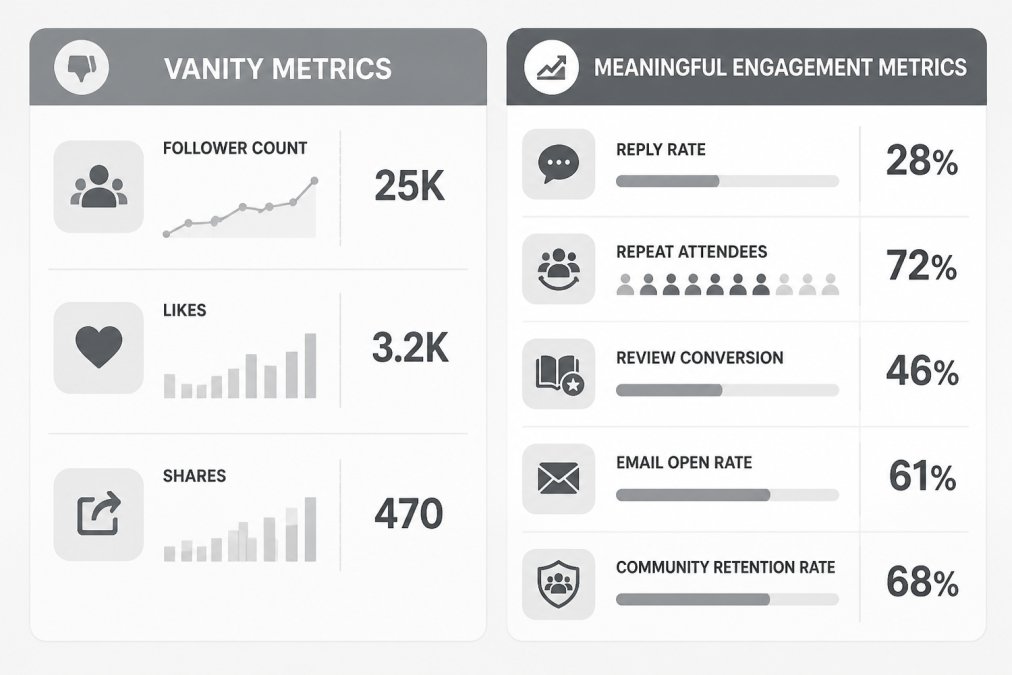
Follower count and likes are vanity numbers. They tell you how many people passed by, not how many came back. Track five metrics monthly, and treat them as a dashboard rather than a scorecard:
- Reply rate, percentage of posts that get at least one reader reply. A healthy small group often sits well above 50%; a large silent group can sit under 5%.
- Repeat attendees, readers who show up to two or more events or live sessions. This is your superfan pipeline.
- Review conversion, readers who leave a review after finishing a book, measured against how many you asked.
- Email open rate, a rough proxy for whether your list still trusts you. A steady decline is an early warning sign.
- Community retention rate, members still active 90 days after joining. This is the single best predictor of whether your community will compound.
The Infrastructure Behind the Numbers
Technical infrastructure matters here too. If your community lives across five tools, you will lose track of who is engaged and who is drifting. Pick a hub, connect your email tool to it, and keep a simple spreadsheet of your most active readers. Review it monthly and reach out personally to anyone who was active last quarter and has gone quiet, a single check-in message often brings them back.
Frequently Asked Questions
What are the best platforms to build an author-reader community?
The right platform depends on where your niche audience already gathers. Facebook groups and Goodreads work well for genre fiction readers, while Substack and email newsletters suit nonfiction authors who want direct control over their reader base. Discord and Slack communities attract younger readers who prefer real-time conversation. Start with one platform where your readers already are, rather than spreading thin across five. You can expand once your community shows consistent engagement.
How do you keep a reader community engaged over time?
Consistency matters more than volume. A weekly Q&A session, monthly virtual events, or a regular newsletter with behind-the-scenes content keeps readers returning. Ask questions that invite reader feedback, feature user-generated content like fan art or book reviews, and celebrate milestones together. Rotate formats so the community does not feel repetitive. Most importantly, show up yourself. Readers join for the books but stay for the authentic connection with the author.
How can indie authors leverage existing book clubs to grow their audience?
Book clubs are one of the most underused growth channels for indie authors. Research genre-matched clubs through libraries, local bookstores, and online directories. Reach out with a personalized pitch offering a free copy, a Q&A session, or a virtual author talk. One book club selection reaches multiple readers at once and often leads to book reviews and word of mouth. A systematic outreach approach helps you contact the right clubs consistently instead of relying on occasional luck.
How do you turn casual readers into a dedicated community?
Move readers from passive consumers to active participants. Invite them to vote on cover designs, share early drafts, or suggest character names. Create a mailing list with exclusive content that rewards sign-ups. When someone leaves a book review, thank them personally and invite them to your next virtual event. Small gestures of recognition build loyalty. Over time, these engaged readers become your strongest advocates, driving word of mouth and reader retention without paid advertising.