Table of Contents
- Why Podcast Interviews Sell Books (and How to Get Them)
- How to Find Podcasts for Book Promotion
- Podcast Pitch Email Template for Authors
- How to Prepare for a Book Podcast Interview
- Follow-Up and Handling Rejection
- After the Interview: Promotion and Book Sales
- Frequently Asked Questions
Last Updated: September 27, 2026
Why Podcast Interviews Sell Books (and How to Get Them)
Podcast interviews sell books because they put you in front of listeners who already trust the host. That trust transfers to you. A single well-placed episode can reach thousands of readers who would never have found your title on their own.
The catch? You have to learn how to pitch your book to podcast hosts for interviews. Most authors skip the pitch and just hope. That doesn't work.
The good news: hosts need guests. Most shows run weekly, and producers are always hunting for interesting voices. Your job is to make their job easy.
Below, we'll walk through finding the right shows, writing a pitch that gets replies, preparing for the interview, and turning one appearance into lasting book sales.
How to Find Podcasts for Book Promotion
Finding podcasts for book promotion starts with genre fit, not download numbers. A small show with the right listeners beats a huge show with the wrong ones.
Genre-Matched Podcast Research
Start with shows that already cover your topic. If you wrote a cozy mystery, look for true-crime and mystery fan shows. If you wrote a business book, look for founder and leadership podcasts.
A common mistake is pitching any show that interviews authors. That's too broad. Hosts can tell when you haven't listened.
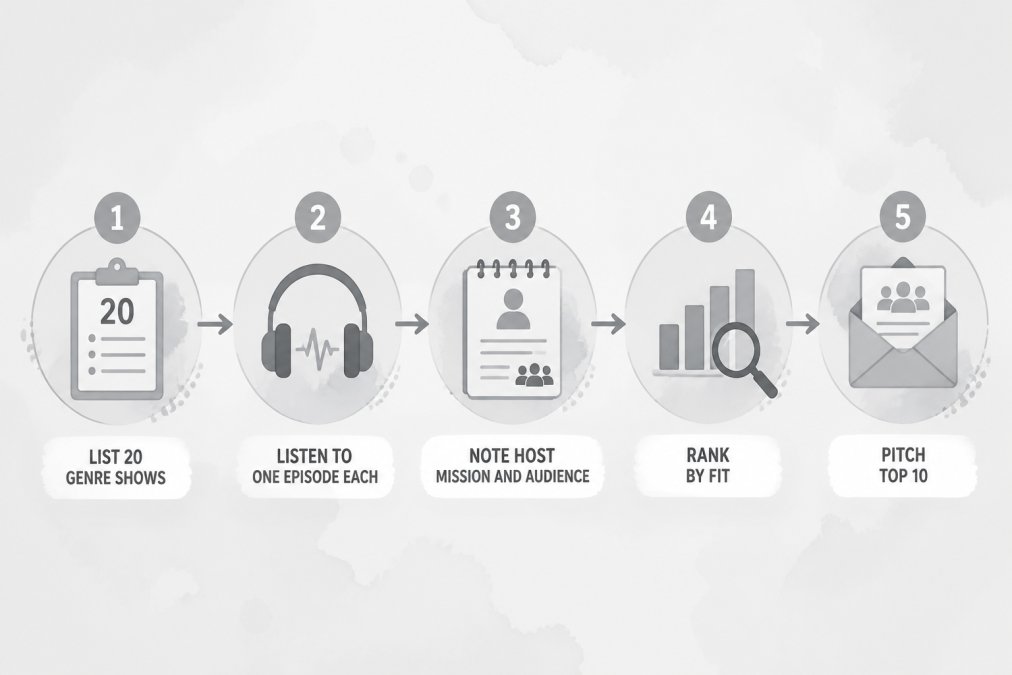
Try this approach:
- List 20 shows in your genre or topic area
- Listen to one full episode of each
- Note the host's mission, tone, and audience
- Rank them by fit, not by size
Shows with a clear "host mission" are easier to pitch. You can speak directly to what they care about.
Tools for Finding Podcast Guest Opportunities
Several tools make the search faster. Podcast directories let you search by category and read show notes. Some platforms list shows actively seeking guests.
A practical mix:
- Podcast directories for category browsing
- Guest-matching platforms for open calls
- Social media groups where hosts post guest requests
- Your own newsletter, asking readers which shows they love
What most guides miss: your existing readers are the best research tool. Ask them what they listen to. You'll find shows no directory would surface.
Podcast Pitch Email Template for Authors
A strong podcast pitch email template for authors does five things: it names the show, shows you listened, offers a clear angle, proves you're qualified, and asks for one small next step. But here's what most guides skip: the pitch that lands for a novelist is not the pitch that lands for a business author. Fiction and non-fiction hosts want different things, and your template needs to flex accordingly.
The Universal Pitch Structure
Every pitch, regardless of genre, follows the same skeleton:
Subject: Guest idea for [Show Name]: [Specific Angle]
Hi [Host First Name],
I listened to your episode with [Guest Name] on [Topic]. Your point about [Specific Detail] stuck with me.
I'd love to offer a follow-up angle: [One-Sentence Episode Idea]. It ties to my book, [Book Title], which covers [Core Topic].
Three things I could bring to your audience:
- [Takeaway 1]
- [Takeaway 2]
- [Takeaway 3]
I'm happy to send a copy of the book and a short bio. Would a 30-minute recording work for you?
Thanks for the work you put into the show.
[Your Name]
That skeleton works. What changes is the middle, the angle, the takeaways, and the proof you're worth an hour of the host's time.
Fiction Author Pitch Template
Fiction hosts, especially those covering mystery, romance, sci-fi, fantasy, and literary fiction, care about story, craft, and the reader experience. They do not want a book summary. They want a conversation that entertains their listeners.
Subject: Guest idea for [Show Name]: The real research behind [Book Title]
Hi [Host First Name],
Your episode with [Guest Name] about [craft/topic] made me think of a question your listeners might enjoy: [Provocative question tied to your book's world].
I write [genre] and my latest book, [Book Title], is about [one-line premise].
Non-Fiction Author Pitch Template
Non-fiction hosts, business, health, self-development, history, want frameworks, data, and a clear promise of what the listener will walk away with. Lead with the transformation.
Memoir and Hybrid Authors
If your book blends personal story with a broader theme, addiction and recovery, grief, caregiving, immigration, pitch the theme first, the memoir second. Hosts in this space want emotional resonance plus a takeaway their audience can use.
Subject Line Best Practices
Your subject line decides whether the email gets opened. Keep it short and specific.
Good patterns:
- "Guest idea for [Show]: [Angle]"
- "[Book Topic] episode for [Show Name]?"
- "Follow-up to your [Guest] episode"
Personalization That Gets Replies
Personalization means proving you actually listened. Name a specific episode. Quote a moment. Mention a guest.
How to Prepare for a Book Podcast Interview
Preparation for a book podcast interview comes down to two things: knowing your talking points and testing your tech. Nail both, and the conversation flows.
Talking Points and Technical Setup
Write five to seven talking points before the recording. Each should be a story or insight, not a summary of your book.
A simple structure:
- One origin story: why you wrote this book
- Two or three key insights from the book
- One surprising fact or counterintuitive idea
- One story your audience will remember
- One clear call to action for listeners
Common tech mistakes:
- Using a laptop mic in a room with echo
- Sitting in front of a bright window
- Forgetting to silence phone notifications
- Joining from a noisy coffee shop
Follow-Up and Handling Rejection
Follow up once, about a week after your pitch. Keep it short and friendly. If there's no reply, move on. That's the standard advice, and it's correct, but it's incomplete. The real skill isn't sending one follow-up. It's knowing what to do when your pitch isn't landing, and how to iterate without burning bridges.
The One-Week Follow-Up
Wait seven days. Reply to your own original email so the host sees the thread. Keep it to two sentences.
Reading the Silence: When to Iterate vs. When to Walk
No reply is data. Before you write off the show, ask three questions:
- Did the pitch match the show's recent episodes? If the last ten episodes were all about [topic A] and you pitched [topic B], the silence isn't personal. It's a fit problem.
- Was your angle specific enough to say no to? Vague pitches are easy to ignore. A pitch that says "I can talk about writing" gets deleted. A pitch that says "I can break down the three-step outline method I used to write 40,000 words in 30 days" gets a reply, even if it's a no.
- Did you pitch the host or the producer? Some shows route pitches to a producer. If the show notes list a producer name, pitch them directly.
The Iteration Loop
When a pitch gets no reply, don't send the same email to the next show. Change one variable and test it.
- Angle: Swap the episode idea. Same book, different hook.
- Subject line: Try a question instead of a statement.
- Proof: Add one concrete credential or result you left out the first time.
- Length: Cut your pitch by a third. Shorter almost always wins.
When a Host Says No
A "no" often means "not right now," not "never." How you respond determines whether the door stays open.
What to do after a no:
- Thank the host for their time, one sentence, no pitch attached
- Ask if they'd like to be notified about your next book
- Add the show to a "revisit in six months" list with a note about what they cover
- Keep pitching other shows the same week
After the Interview: Promotion and Book Sales
The interview is the start, not the finish. Post-interview promotion is where book sales actually happen.
A simple promotion checklist:
- Share the episode link with your email list
- Post a clip with a quote on social media
- Add the episode to your author website's media page
- Thank the host publicly and tag the show
- Mention the episode in your next book's back matter
Frequently Asked Questions
What should be included in a podcast pitch for an author?
A strong podcast pitch for authors includes a personalized subject line, a brief introduction of yourself and your book, why you are a good fit for the host's specific audience, 2-3 talking points you can discuss, and a clear call to action. Keep it under 150 words and attach your media kit or guest bio. Show you have listened to the show and understand the host's mission.
How do I follow up on a podcast pitch without being annoying?
Wait 7-10 days after your initial pitch before following up. Send a short, polite email that adds value, such as a new angle or a timely hook related to your book. If you do not hear back after two follow-ups, move on. Podcast hosts are busy, and a respectful follow-up sequence shows professionalism without pressure.
How do I find the right podcasts to pitch my book to?
Start by searching podcast directories for shows in your genre or topic. Look for podcasts that feature author interviews and have an audience aligned with your book's target readers. Check episode recency, guest history, and listener engagement. Tools like Listen Notes or PodMatch can help, but genre-matched research is key to finding shows where your book will resonate.
How do I prepare for a book podcast interview?
Prepare 3-5 talking points that connect your book's themes to the host's audience. Practice concise answers that include stories or examples. Test your audio setup, use a quality microphone, and find a quiet space. Research the host's recent episodes to match their tone. Have your book's key takeaways ready and a clear call to action for listeners.